Soldered Electrochemical O2 Gas Sensor Breakout (Qwiic)
Oxygen sensor board with an SGX-4OX-ROHS electrochemical cell for 0 to 25 % vol, read by an LMP91000 and a 16-bit ADC over Qwiic.
This board measures oxygen (O2) with an SGX-4OX-ROHS electrochemical cell. The LMP91000 analog front end biases the cell and turns its current into a voltage, a 16-bit ADS1115 ADC converts that voltage, and an ATtiny404 talks to both chips for you, so your microcontroller sees a single I2C device.
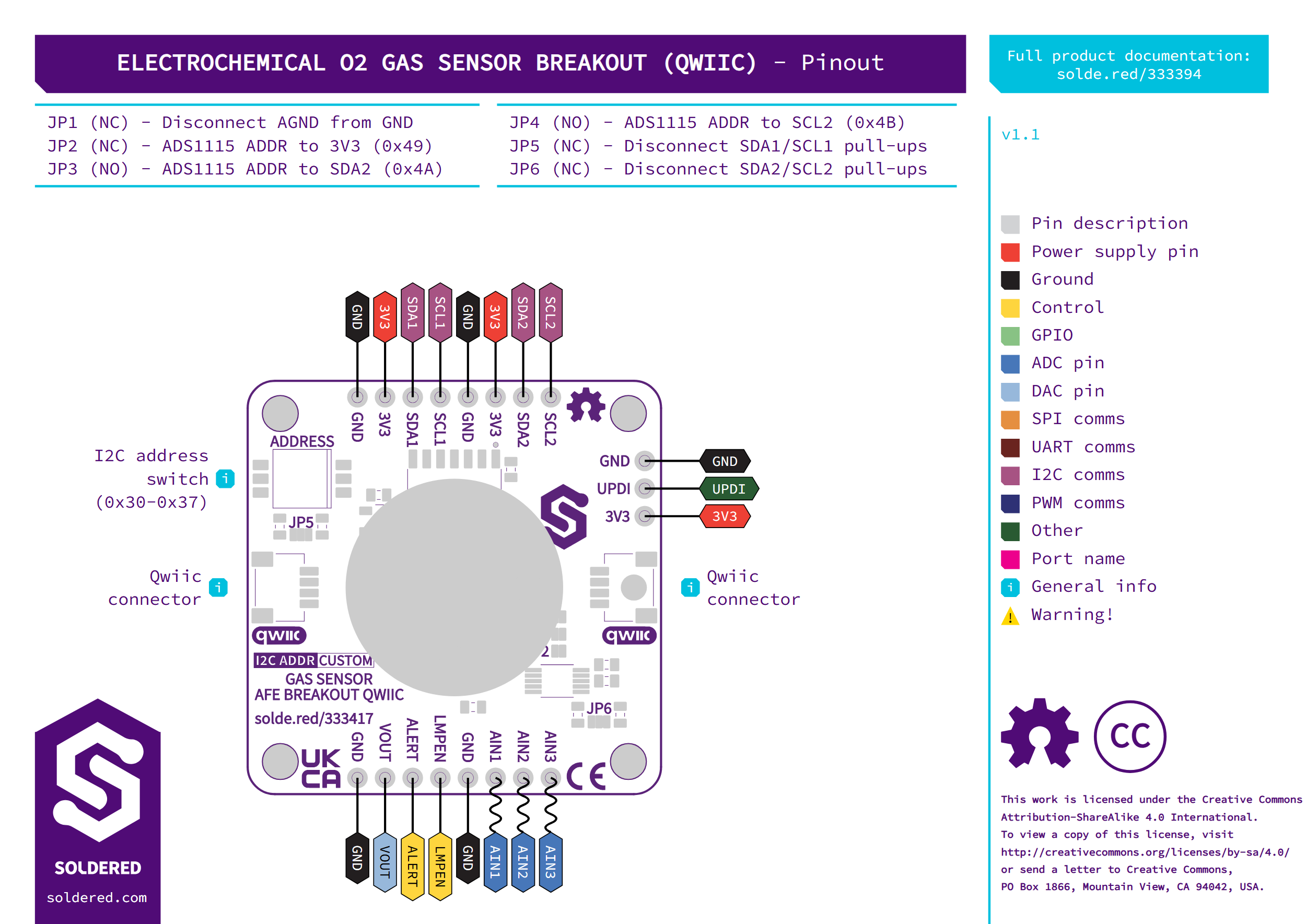
The cell covers 0 to 25 % vol and reaches 90% of a step in under 10 s. It works from -40 to 60 °C and 15 to 90% RH. The cell needs a −600 mV bias, and after power-up it can take up to 15 minutes to settle. The libraries have no preset for this cell yet, so you set the front end's bias and gain yourself. The ADS1115's other three inputs, AIN1 to AIN3, are on a header for your own analog signals.
Connect the board with either of the two Qwiic connectors or the 2.54 mm headers. It runs from 3.3 V; there is no regulator, so the header and the Qwiic connectors share one 3.3 V supply. The default address is 0x30; the three DIP switches move it from 0x30 to 0x37, so up to eight boards share one bus. The front end's analog output VOUT and the ADC's ALERT pin are on the header too. There are libraries for Arduino and MicroPython, plus an ESP-IDF component and an ESPHome component.
- Gas: oxygen (O2)
- Gas cell: SGX-4OX-ROHS, electrochemical
- Range: 0 to 25 % vol
- Response time: T90 under 10 s
- Repeatability: < ±2%
- Operating conditions: -40 to 60 °C, 15 to 90% RH
- Expected cell life: over 60 months in air
- Analog front end: Texas Instruments LMP91000
- ADC: Texas Instruments ADS1115, 16-bit
- Bridge MCU: Microchip ATtiny404 (factory firmware)
- Interface: I2C, address 0x30 (0x30 to 0x37 by switch)
- Supply: 3.3 V, no regulator; the Qwiic connectors share this supply
- Header pins: VOUT (analog out), ALERT, AIN1 to AIN3 (analog in)
- Connectors: 2x Qwiic, 2.54 mm headers
- Dimensions: 38 x 38 mm
Interface
| Interface | I2C, Analog, Digital Gpio |
|---|---|
| Qwiic Compatible | Yes |
| I2C Address Default | 0x30 |
| I2C Address Changeable | Yes |
| Breadboard Compatible | No |
Measurement
| Measurement Types | Gas |
|---|---|
| Measurement Range | 0 to 25 % vol O2 (SGX-4OX-ROHS); max overload 30% O2 |
| Measurement Accuracy | Repeatability < ±2%; logarithmic output S = K ln(1/(1-C)); T90 under 10 s; output 0.1 ± 0.03 mA in air |
Power
| Supply Voltage Min V | 3.3 |
|---|---|
| Supply Voltage Max V | 3.3 |
| Logic Level | 3V3 Only |
Other
| Ic Part Number | LMP91000 |
|---|---|
| Mcu Part Number | ATtiny404 |
Plug into any Soldered Dasduino or microcontroller with an easyC cable — no soldering required.
Add the Soldered library for your language (below).
Open the get-started example and read your first value.