Soldered Ultra-Low-Power Accelerometer BMA400 Breakout
A 3-axis BMA400 accelerometer on a Qwiic breakout. It measures ±2 g to ±16 g and draws 160 nA in sleep mode.
The Ultra-Low-Power Accelerometer BMA400 Breakout carries the Bosch BMA400, a 12-bit 3-axis accelerometer made for battery-powered devices. Besides raw acceleration, the chip counts steps, detects taps, orientation and activity changes, and buffers samples in a 1 KB FIFO, so your microcontroller can sleep until an interrupt wakes it.
You pick a range of ±2 g, ±4 g, ±8 g or ±16 g and an output data rate from 12.5 Hz to 800 Hz in normal mode. The BMA400 draws 14.5 µA in normal mode at its highest performance setting, 850 nA in low-power mode at 25 Hz and 160 nA in sleep mode (datasheet values at 1.8 V and 25 °C).
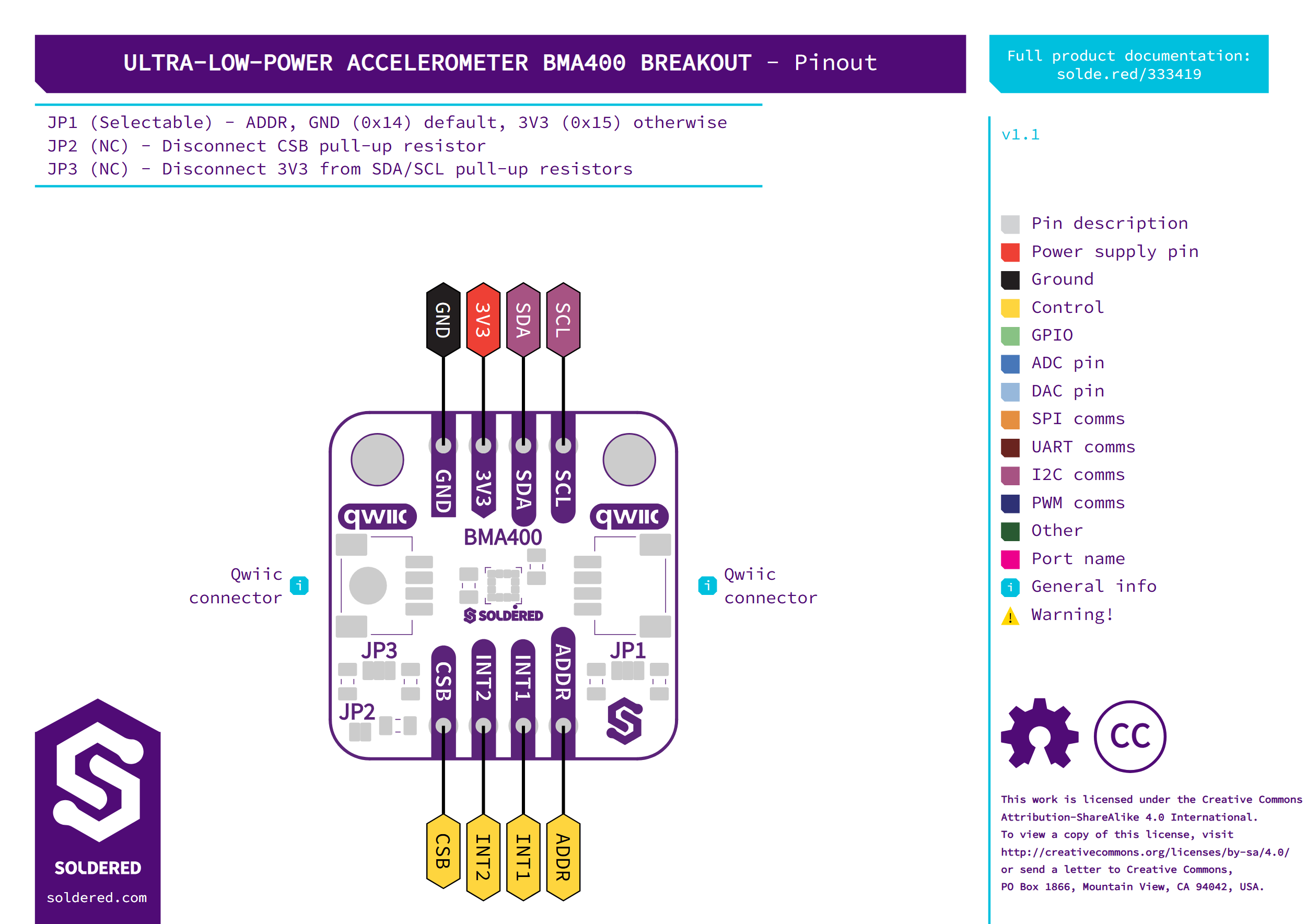
The board talks I2C at address 0x14, or 0x15 when you change the ADDRESS jumper or pull the ADDRESS pin high. Two Qwiic connectors let you chain it with other boards, and two 4-pin 2.54 mm headers break out GND, 3V3, SDA, SCL, ADDRESS, INT1, INT2 and CSB. The 10 kΩ pull-ups on SDA and SCL can be disconnected with a jumper. Soldered provides an Arduino library and a MicroPython library with examples for readings, motion detection and step counting.
- Sensor: Bosch BMA400, 12-bit, 3-axis
- Range: ±2 g, ±4 g, ±8 g, ±16 g
- Output data rate: 12.5 to 800 Hz (normal mode), 25 Hz (low-power mode)
- Sensitivity: 1024 LSB/g at ±2 g
- Zero-g offset: 50 mg typical
- Noise density: 180 µg/√Hz (X, Y), 240 µg/√Hz (Z), normal mode, OSR=3
- Current (datasheet, 1.8 V, 25 °C): 14.5 µA normal mode (OSR=3), 850 nA low-power mode (25 Hz), 160 nA sleep mode
- Operating temperature: -40 to +85 °C
- Interface: I2C, address 0x14 (default) or 0x15; INT1 and INT2 interrupt pins
- Supply: 1.72 to 3.6 V on the 3V3 pin
- Connectors: 2x Qwiic, 2x 4-pin 2.54 mm header (unsoldered)
- I2C pull-ups: 10 kΩ on SDA and SCL, disconnectable with a jumper
- Mounting holes: 2x 3.2 mm
- Dimensions: 22 x 22 mm
Interface
| Interface | I2C, Digital Gpio |
|---|---|
| Qwiic Compatible | Yes |
| I2C Address Default | 0x14 |
| I2C Address Changeable | Yes |
| Breadboard Compatible | Yes |
Measurement
| Measurement Types | Acceleration |
|---|---|
| Measurement Range | ±2 g, ±4 g, ±8 g, ±16 g (selectable); ODR 12.5 to 800 Hz in normal mode, 25 Hz in low-power mode |
| Measurement Accuracy | Zero-g offset 50 mg typ.; sensitivity 1024 LSB/g at ±2 g; noise density 180 µg/√Hz (X, Y), 240 µg/√Hz (Z), normal mode OSR=3, 25 °C |
Power
| Supply Voltage Min V | 1.72 |
|---|---|
| Supply Voltage Max V | 3.6 |
| Logic Level | 3V3 Only |
| Operating Current (mA) | 0.0145 |
| Sleep Current Ua | 0.16 |
Other
| Ic Part Number | BMA400 |
|---|
Plug into any Soldered Dasduino or microcontroller with an easyC cable — no soldering required.
Add the Soldered library for your language (below).
Open the get-started example and read your first value.