With E-paper, Enclosure & Battery
Inkplate 7SPECTRA in a 3D-printed enclosure with a 1200 mAh Li-ion battery, so the 7.3-inch six-color e-paper board runs on its own.
Inkplate 7SPECTRA is an e-paper development board built around a 7.3-inch E Ink Spectra 6 panel with 800 x 480 pixels. The panel shows six colors: black, white, yellow, red, blue and green. An ESP32-S3-WROOM-1-N8R8 module on the board runs your code and drives the panel, so you need no other controller.
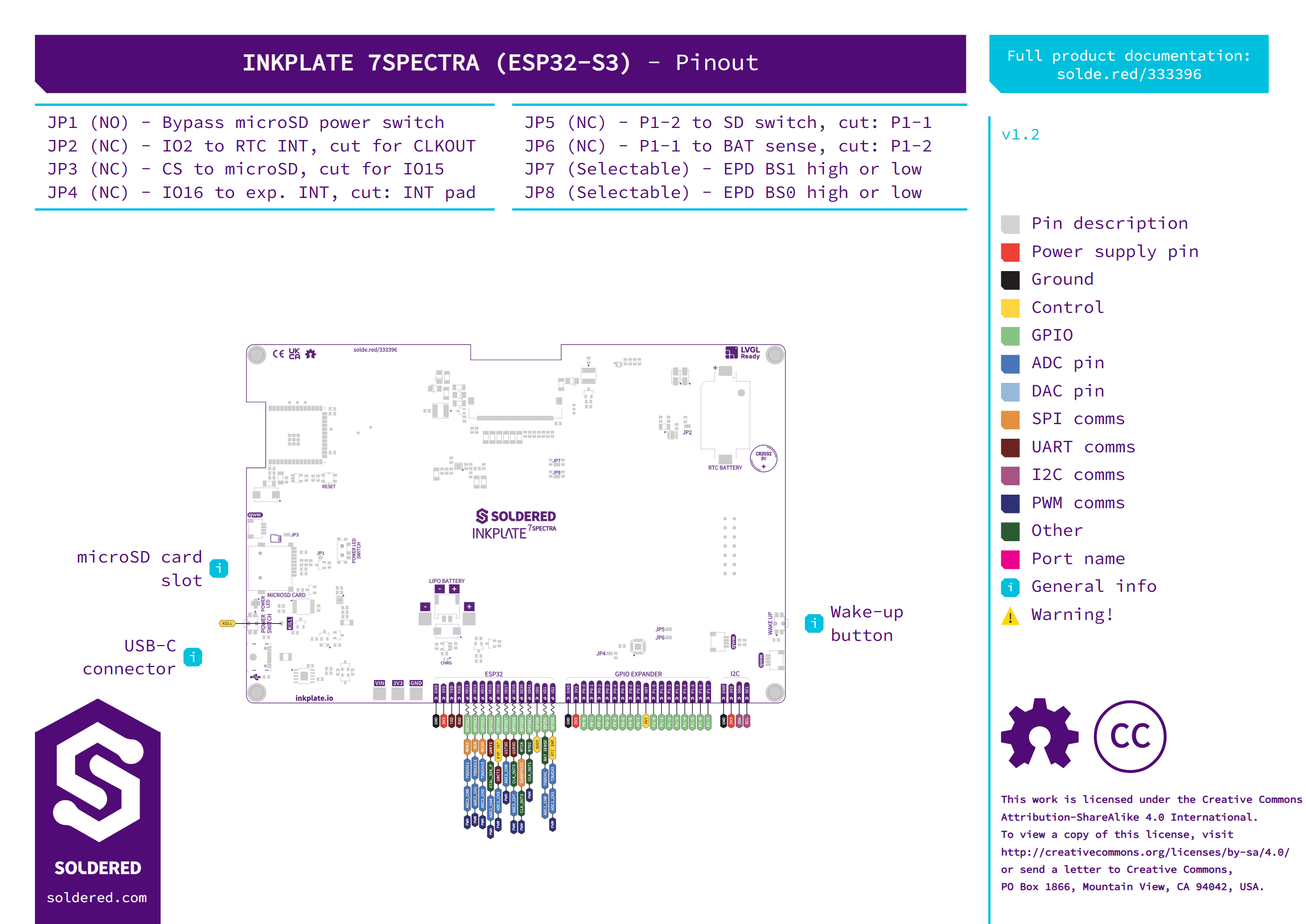
The ESP32-S3 runs at up to 240 MHz with 8 MB of flash and 8 MB of PSRAM, and it has Wi-Fi (802.11 b/g/n) and Bluetooth 5 LE. A PCF85063A real-time clock with a CR2032 holder keeps time while the board sleeps, and a microSD slot holds images and data. You power the board over USB-C or from a 3.7 V Li-ion battery on the 2-pin JST connector, and the MCP73831 charger on the board charges the battery whenever USB-C is connected. A slide switch turns the board off, and a wake-up button on IO18 brings it out of deep sleep.
Three Qwiic connectors put the I2C bus on the edge of the board, and a PCAL6416A expander adds 16 GPIO pins next to the free ESP32-S3 pins on the pads along the edge. The Inkplate Arduino library has an Inkplate7SPECTRA board file with examples, and the Inkplate MicroPython module supports the board as inkplate7spectra. Programming and serial go over USB-C through a CH340K. The board ships with a USB-C cable. A version with a 3D-printed enclosure and a 1200 mAh battery is sold separately.
- Display: E Ink EL073TF1C8, 7.3 inch, 800 x 480 pixels, six colors (black, white, yellow, red, blue, green)
- Update: full-screen updates only, the driver has no partial update
- Microcontroller: ESP32-S3-WROOM-1-N8R8, dual-core, up to 240 MHz
- Memory: 8 MB flash, 8 MB PSRAM
- Wireless: Wi-Fi 802.11 b/g/n (2.4 GHz), Bluetooth 5 LE
- USB: USB-C for programming, serial and charging, CH340K USB to UART
- Battery: 2-pin JST connector for a 3.7 V Li-ion battery, MCP73831 charger, battery voltage measurement
- Clock: PCF85063A RTC with CR2032 holder
- Storage: microSD card slot
- Expansion: 3 Qwiic (I2C) connectors, PCAL6416A 16-pin GPIO expander, ESP32-S3 GPIO pads
- Controls: on/off slide switch, wake-up button (IO18), reset button
- Board size: 176.2 x 117.2 mm
- Programming: Arduino IDE (Inkplate library), MicroPython (Inkplate module)
- In the box: board with panel, USB-C cable
Display
| Display Size (inch) | 7.3 |
|---|---|
| Display Resolution W | 800 |
| Display Resolution H | 480 |
| Display Color | Color |
| Frontlight | No |
| Touch Support | None |
MCU
| Mcu Part Number | ESP32-S3-WROOM-1-N8R8 |
|---|---|
| Mcu Clock (MHz) | 240 |
Connectivity
| Wifi | Wifi4 |
|---|---|
| Bluetooth | Ble 5 |
Interface
| Qwiic Compatible | Yes |
|---|---|
| Sd Card Slot | Yes |
Power
| Battery Included | No |
|---|---|
| Battery Connector | Jst 2Pin |
Other
| Dev Environments | Arduino IDE, MicroPython |
|---|---|
| Has Enclosure | No |
| Rtc Onboard | Yes |
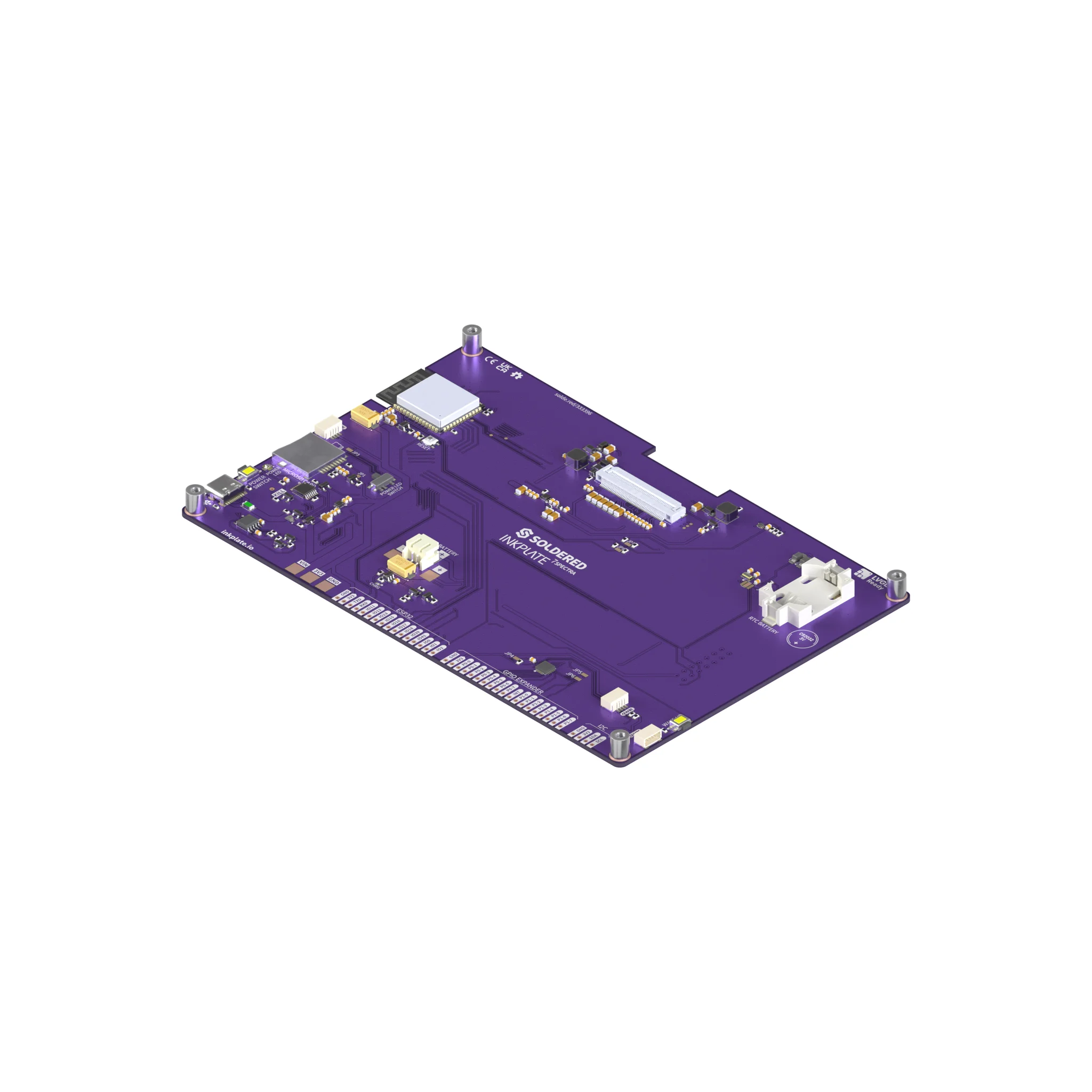
Connect over USB-C (optional Li-Po battery for portable use).
Install the board definition and library for your language (below).
Upload the first sketch or script and see it work.