Soldered NULA Node RP2040
The NULA Node is a versatile RP2040 development board with built-in WiFi and Bluetooth, ideal for rapid prototyping and IoT projects.
The Soldered NULA Node RP2040 is a development board with the radio already on it. It pairs Raspberry Pi's dual-core Cortex-M0+ RP2040 at 133MHz with the Raspberry Pi Radio Module 2, so you get WiFi 4 and Bluetooth 5.2 without a second board. There is 264KB of SRAM and 16MB of flash, enough for a filesystem, web assets and your code at the same time.
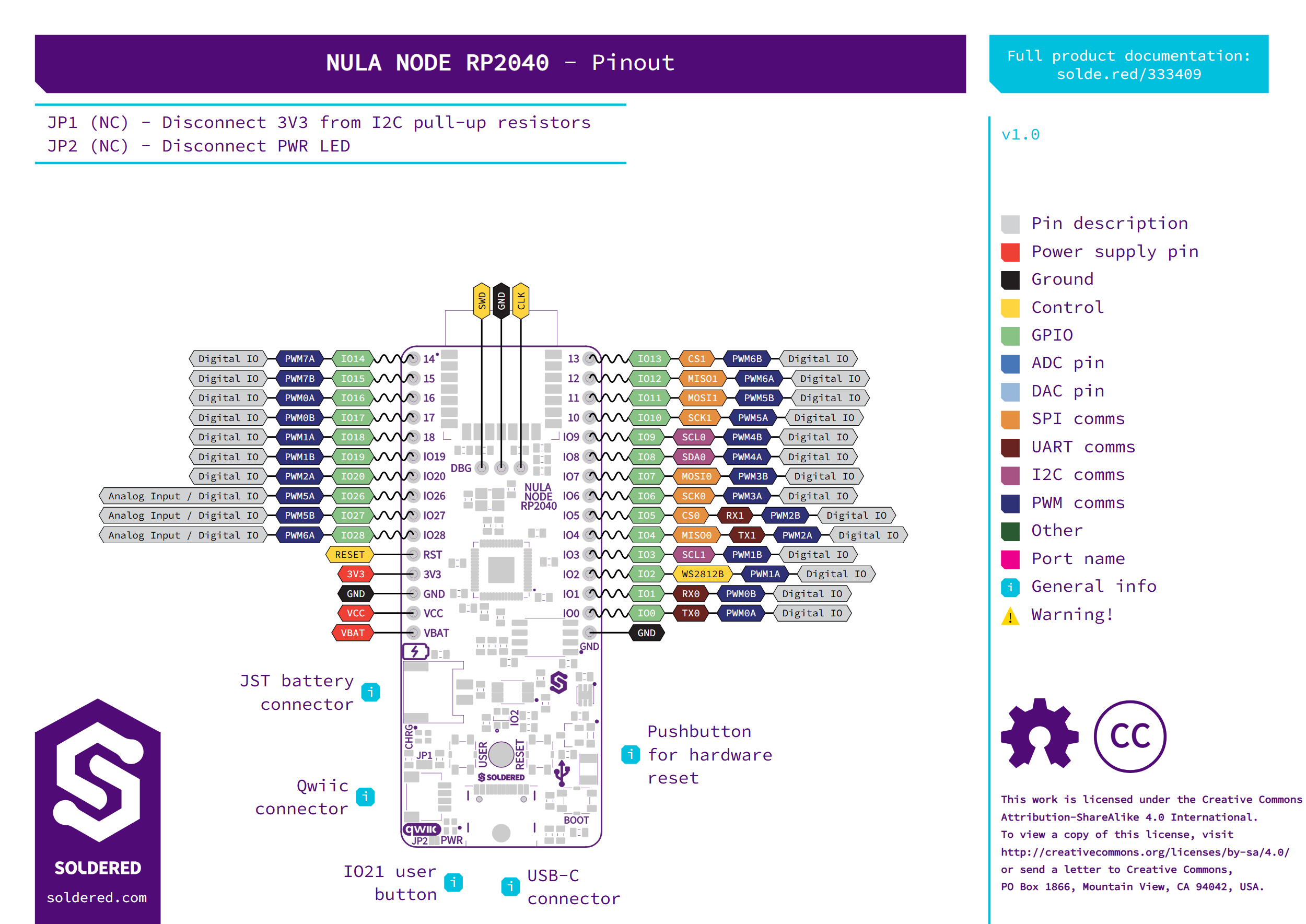
The board brings out 24 GPIO on two 15-pin headers. Three of them read analogue voltages with a 12-bit ADC. A Qwiic port connects an I2C sensor with one cable and no soldering. An addressable WS2812B LED and a user button are already fitted, so you can write your first sketch before you wire anything up. The header rows sit 0.9 inch apart, and the headers come unsoldered, so the board fits a breadboard once you solder them on.
A 2-pin JST connector and an onboard charger take a 3.7V Li-Ion battery. The board picks USB or battery on its own, so unplugging the cable does not reset your project. Program it over USB-C in Arduino, MicroPython, CircuitPython or the C/C++ SDK. The 3-pin SWD header is there when you want a hardware debugger. The design is open source under GPLv3 and made in the EU. A USB-C to USB-C cable is included in the package, so you can start programming right out of the box.
Note:
- Before connecting a 3.7V Li-Ion battery, please refer to the detailed technical documentation which you may find on this page
- Dual-core Arm Cortex-M0+: RP2040 at 133 MHz.
- Memory: 264 KB SRAM and 16 MB flash.
- WiFi 4: 802.11 b/g/n on 2.4 GHz, through the Raspberry Pi Radio Module 2.
- Bluetooth 5.2: Classic and Low Energy.
- 24 GPIO: On two 15-pin headers, three of them with a 12-bit ADC.
- Qwiic connector: Plug in an I2C sensor with one cable, pull-up resistors already fitted.
- Addressable LED: An onboard WS2812B you can drive from the first sketch.
- User and reset buttons: Both on the board, no wiring needed.
- Battery ready: 2-pin JST connector and a Li-Ion charger, with automatic switching between USB and battery.
- USB-C: Power, programming and serial over one connector, with a 500 mA fuse.
- 3.3 V logic level.
- SWD header: Three pins for a hardware debugger.
- Breadboard friendly: 26 x 65 mm, header rows 22.86 mm (0.9 inch) apart, headers included unsoldered.
- Open source: Schematics and PCB files published under GPLv3.
- Programming: Arduino IDE, PlatformIO, MicroPython, CircuitPython and the C/C++ SDK.
MCU
| Mcu Part Number | RP2040 |
|---|---|
| Mcu Clock (MHz) | 133 |
| Sram (KB) | 264 |
| Flash (MB) | 16 |
Connectivity
| Wifi | Wifi4 |
|---|---|
| Bluetooth | Classic And Ble |
| Wireless Module | Raspberry Pi Radio Module 2 |
Interface
| Gpio Count | 24 |
|---|---|
| Qwiic Compatible | Yes |
| Breadboard Compatible | Yes |
Power
| Battery Connector | Jst 2Pin |
|---|---|
| Onboard Battery Charger | Yes |
| Supply Voltage | 3V3 5V |
| Logic Level | 3V3 |
Other
| Dev Environments | Arduino IDE, PlatformIO, MicroPython, CircuitPython, C/C++ SDK |
|---|
Connect over USB-C (optional Li-Po battery for portable use).
Install the board definition and library for your language (below).
Upload the first sketch or script and see it work.